
 post | March 31, 2019
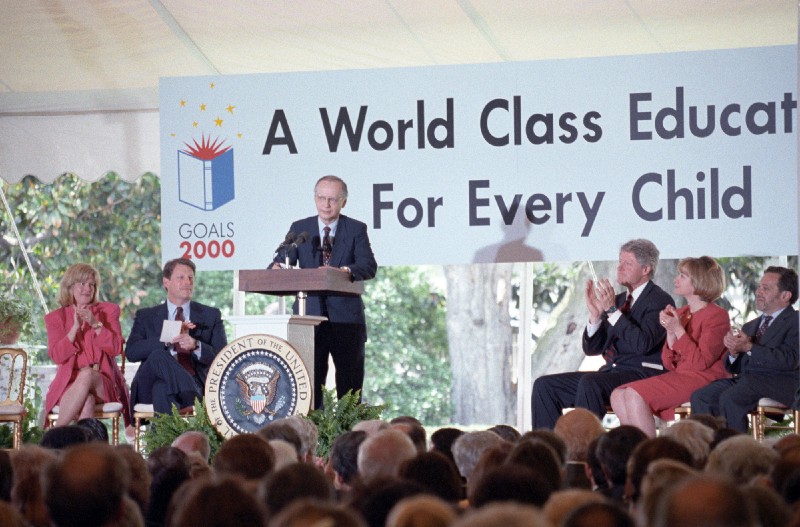
When I arrived in Washington in January 1993 to serve as the nation’s sixth Secretary of Education, I was confident that President Bill Clinton would make public education a very high priority. After all, when I was governor of South Carolina, I had seen then Governor Clinton — and Hillary, then First Lady of Arkansas — up close as he persuaded, innovated, pushed, and prodded to turn Arkansas into a model of public education reform for the benefit of its schools and students.
As we celebrate the 25th anniversary of the signing of the landmark Goals 2000: Educate America Act, I’ve been thinking a lot about those early days.
A commitment to a quality public education for all children
President Clinton and I were elected on the same day in 1978 to begin service in January 1979, and we met a month later at the National Governors Association. We were dealing with similar problems. Both of our states still groaned under the weight of past segregation that left many African-American students in underperforming schools. In many of our rural areas, pockets of high poverty and lower education quality adversely affected some predominantly white communities, too. We both, as governors, were determined to make a quality public education available to all children, no matter where they lived or the color of their skin. Here’s what we knew: industries want to locate in a state that provides an educated workforce for their business and a high-quality public education for their children who will relocate there.
Bill and I were fortunate to serve as governors in the 1980s, along with a bipartisan group of Southern governors who recognized the important link between economic growth and improving public education. We all were members of the Southern Regional Education Board — 16 states ranging from Texas to Delaware. After much hard work, we adopted a set of education goals for our region, Challenge 2000, that covered many aspects of Pre-K through higher education, including teaching support. Chief among those goals was setting academic standards in six K-12 subjects and benchmarks that aligned with the standards so that improvement could be measured. Many of us got those reforms enacted in our respective states and public education improved dramatically in the South, especially in South Carolina and Arkansas.
Then, in 1989, President Bush held a national education summit attended by all governors, Republicans and Democrats alike, and other education leaders. That summit highlighted that public education must be a national priority, and Challenge 2000 became the basis for the goals adopted there. The governors and the administration agreed to some very significant ideas — including setting standards for competency in five core academic subjects and assessments aligned with the standards.
A new level of partnership with states and local school districts
When Bill Clinton came to Washington in 1993, he wanted to improve public education across the nation. He knew the value of a good education for all children, but especially for poor children and even more so for poor children of color. We had a strong set of fundamentals in place in our respective states; our new president knew what he wanted to achieve nationally and how he wanted to do it.
One of my very first meetings with President Clinton in the Oval Office was about codifying into federal law the national education goals adopted by the governors at the 1989 summit. With encouragement from me and my chief education counselor, the president felt strongly that we should broaden the scope of the core subjects to include civics and the arts. The need for including civics is obvious, especially these days. But President Clinton was adamant in 1993 that instruction in the arts is essential for a child’s well-rounded education, and a key contributor to better learning in all other subjects. And, he recognized that inclusion of the arts as a core academic subject in Goals 2000 would enable the use of federal monies by states for arts instruction and curriculum in Title I schools. Further, states then would be expected to include the arts in their state goals, plans, standards, and appropriations.
We spent all of 1993 working with members of Congress, state and local officials, and other education leaders to develop and gain support for the Goals 2000 legislation. We made it clear that enshrining the goals into federal law would be a statement of national aspiration, not federal mandate. We wanted to make the federal government a junior partner in state-led, standards-based reform.
We proposed that the states would set competency standards for all students, implement state assessments aligned with the standards to hold schools accountable, and develop a comprehensive plan for improving student achievement. In return, the federal government would provide the states with additional funds and technical assistance to support their efforts to set standards and develop an implementation plan; give broad flexibility in the particulars of each plan, including state control over the standards; and extend complete flexibility over the use of Goals 2000 funds — as long as the funds were used to carry out the state’s reform plan.
Every step of the way, the president would suggest an idea or ask what progress we were making in helping students and supporting teachers. He ran his campaign on “Putting People First,” and he was invested in getting this done, as was I.
In October 1993, the House passed its version of the Goals 2000 bill. By early 1994, the Senate hadn’t acted yet. So, in January we visited 11 states to promote the importance of the legislation, often joined by Senate leaders like Elizabeth Dole and Lamar Alexander. The Senate passed its version in February, and the compromise House-Senate Conference Report was approved late in March, less than 11 months after it had been introduced. There was just one more small hurdle — the legislation required the president’s signature by March 31, and he was vacationing in California. But in keeping with his emphasis on the importance of the arts in education, President Clinton signed the Goals 2000: Educate America Act into law on March 31, 1994, at San Diego Unified School District’s Zamorano Fine Arts Academy.
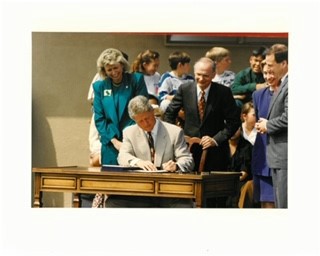
President Clinton signed the Goals 2000: Educate America Act into law on March 31, 1994, at San Diego Unified School District’s Zamorano Fine Arts Academy.
It was exciting and rewarding to attend the bill signing, just those few years after then-Governor Clinton and I had first discussed the importance of codifying the national education goals into law. When President Clinton handed me one of the signing pens, I was beaming. We had fought hard to get those national education goals into federal law because we were convinced of the favorable impact that could have on teaching and learning for all of our nation’s students.
President Clinton called the law “a new and different approach for the federal government.” Instead of the traditional federal regulatory approach, it was a new model of partnership with states and local school districts that encouraged innovation, promoted flexibility and cut red tape. The law authorized $400 million per year for grants to states and school districts to design and adopt reform plans that set high standards for student achievement and strategies for providing appropriate tools and services to help students learn to those high standards. Public education would remain primarily a state and local responsibility, but this law established that it is indeed a national priority.
It’s important to note that the Goals 2000: Educate America Act was administered without writing a single new regulation. It was a no-strings-attached law and, because that was so novel and unusual, many state leaders were wary of it. We had some difficulty getting the states to believe that we were giving them the money and the flexibility to design their own reform strategies. But when we left office in January 2001, 49 states had adopted state plans that required students to meet challenging standards in core academic subjects, and 48 states were testing for proficiency. Reading and math scores were going up among all students, including the lowest-performing students and students in the highest-poverty schools. The law was making a difference!
A cornerstone for public education reform that lives on
Over the years, education policy has evolved. But the movement to raise achievement levels lives on, built on the foundation advanced by a forward-looking president who saw public education as a pathway to the middle class and the jobs of the future. The Goals 2000: Educate America Act became the Clinton administration’s cornerstone for education reform across the board and we went on to accomplish a lot more — formation of the unique national Arts Education Partnership between the U.S. Department of Education and National Endowment for the Arts, joined by hundreds of local, state and national arts and education organizations to provide additional support for arts education programs; the E-rate that connected 95 percent of public schools and libraries to the internet (up from 35 percent in 1994); measures to strengthen teacher quality and recruitment; dramatic expansion of after-school and summer learning opportunities to 13,000 schools under the 21st Century Community Learning Centers program; GEAR UP to open pathways for middle schoolers to aspire to and prepare for a college experience; increased Pell Grants to make college more affordable for low-income students; the Direct Lending program to reduce the cost of education loans for all students.
These are just a few of our significant accomplishments to reform and improve education, many of which have survived through different presidential administrations and still exist today.
I look back on those eight years, and I think about the enormous good that government can do when people of good will and public interest put their minds to it. That is how Bill Clinton governed, and I am proud to have been a part of it.