
Water & Sanitation Solutions for Haiti
Summary
In 2009, Water.org committed to raising and investing $2,000,000 to reach at least 50,000 people with safe water and sanitation in Haiti during a three-year period through 2012. Water.org works with local partner NGOs, supporting them with its grant-driven programs, and also focuses on financial innovation by exploring relationships with microfinance partners in Haiti under its WaterCredit Initiative.
Approach
Water.org continues to push forward on financial innovations in the water and sanitation space, ensuring balance between subsidy-driven solutions for the absolute poor while offering microfinance and other financial models to those willing and able to bring financial resources to bear. One example is Water.org’s WaterCredit Initiative.
Water.org will bring a mix of solutions to Haiti, tailoring financial offerings through its partner NGOs and, if local financial conditions warrant, through partner microfinance organizations. Additionally, Water.org will invest in a mix of water and sanitation solutions appropriate for local conditions. This program will directly impact the lives of at least 50,000 people lacking safe water and sanitation.
Water.org will support local partner organizations that can deliver effective and sustainable water and sanitation services with a mix of grants, revolving loans, and microfinance approaches. Specific water and sanitation technologies will depend upon local conditions, community demand, local partner recommendations, and Water.org best practices. Prior to construction, partners will assess local conditions, identifying the best water and sanitation solutions through a variety of potential methods: market research studies, baseline and geophysical surveys, and participatory rural appraisals (PRA). Based on previous work, example technologies include, but are not limited to, piped household water connections, shallow and deep wells, overhead tanks, spring catchments, and rainwater harvesting. Specific goals include:
– Increase level of access to sustainable, safe water and sanitation services for 50,000 people among poor and vulnerable populations.
– Decrease prevalence of water- and sanitation-related diseases in target areas.
– Promote integrated water resources management, focusing on maintaining drinking water quantity and quality.
– Increase awareness of good hygiene practices.
– Measure community-level demand for credit-based water-supply and sanitation solutions.
– Assess microfinance institutions’ willingness and ability to develop loan portfolios serving water and sanitation needs of the poor. Subject to positive assessments, build local MFIs’ capacity to launch loan portfolios.
– Build network of local NGO and MFI partners to execute programs.
Background
The water and sanitation situation in Haiti is among the most dire in the Western hemisphere. According to the WHO/UNICEF 2008 Joint Monitoring Program report, only about 70% of urban residents and 51% of rural residents have access to improved water services. Sanitation coverage is also very low in both urban (29%) and rural (12%) areas of the country.
Haiti is considered a water-stressed country. Total available water resources per capita are about 1,660 cubic meters (just under the 1,700 threshold). Less than 1% of these resources are in use. Groundwater potential exists in the mountainous areas and in some coastal areas, but accessing this has been a challenge for many communities. Virtually no water treatment facilities are properly functioning for the general public in the country. Soil erosion and deforestation have also contributed to diminished water quality. Moreover, Haiti’s seasonal rainfall patterns provide too much rain for some during segments of the year and too little for others during the dry season.
Current GDP per capita is approximately in nominal terms and ,318 in purchasing power terms. An estimated 80% of people live under the poverty line.
With the recent merger of the H2O Africa Foundation and WaterPartners, the new Water.org is expanding the number of countries in which it operates. Haiti is a top priority for its next country launch. Drawing on major donations (one ,000 pledge is in place) and grassroots donors through a social media campaign, Water.org will deliver at least ,000,000.00 to fund this commitment.
Progress Update
March 2015
Water.org and its three local partners (Haiti Outreach, PRODEVA, and ASSODLO), addressed the longterm water and sanitation needs of 51,300 people in underserved communities in Haiti.
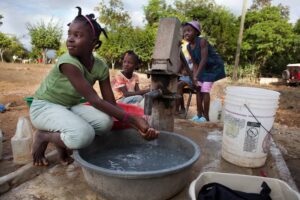
Together, Water.org and Haiti Outreach completed the construction and or rehabilitation of 95 wells in rural communities throughout St. Raphael, Pignon, Hinche, Mirebelais, Boucan Carre and Capotille, reaching 33,700 men, women and children.
Water.org and PRODEVA constructed a community-wide water system for the town of Ennery, Artibonite, that gave an estimated 10,100 people access to safe drinking water. Through a holistic approach, this program created 252 incomegenerating opportunities for Haitians, such as excavating trenches, laying pipes, and transporting materials. Local masons, iron workers, carpenters and plumbers were also hired to assist with the system construction. In addition to the shortterm opportunities, longterm kiosk manager positions were also created and filled. The new water system’s distribution network provides access to water both at the household and communitylevel for families living within Ennery and on the outskirts of the town.
Water.org and ASSODLO constructed a gravity-fed spring catchment and distribution system in a remote region near the mountains south of Carrefour. This project reached 7,500 people with access to a reliable supply of safe drinking water. Through a comprehensive program, local residents also gained access to more than 492 incomegenerating opportunities.
In each of these 97 communities, water management committees were established and provided with training in managing the water points. This included training in financial record keeping, water treatment, and system maintenance.
Water.org will continue to work with Haiti Outreach on expanding safe water access to 10 new communities, reaching an additional 3,000 people in Haiti.