
CGI leaders and partners discuss widespread inequities and challenges for informal economy workers, push for collaborative solutions
Credit: Pro Mujer
Over one-third of the world’s population is currently working or has worked in the informal economy, a fact emphasized during the Clinton Global Initiative’s (CGI) recent event, “Bolstering Economic Security for Informal Economy Workers.” As established by the International Labor Organization, the informal economy refers to “all economic activities by workers and economic units that are – in law or in practice – not covered or insufficiently covered by formal arrangements.”
The virtual event, which gathered stakeholders from across multiple sectors and regions of the world, centered on driving solutions and actions to address inequities that exist within the informal economy, including wage protections, gender inequities, lack of access to capital and technology, and barriers to collective bargaining. In some countries, the informal sector comprises over 90 percent of the overall economy or workforce, said Milan Bhatt, Senior Manager for Inclusive Economic Recovery and Growth at CGI.
Non-standard forms of work such as gig work and freelancing have become more common since the start of the COVID-19 pandemic, said Herwig Immervoll, Head of Employment-Oriented Social Policies and Senior Economist at the Organization for Economic Co-operation and Development. Concerns for protecting non-standard workers have also grown since then. To address these issues, Immervoll emphasized the importance of working within existing social protection structures as opposed to totally dismantling them.
At the height of the pandemic, the Fund Excluded Workers Coalition formed to support workers in New York who were navigating pandemic-related unemployment. Eventually implemented by the New York State Department of Labor in tandem with advocates, the Coalition successfully won the $2.1 billion Excluded Workers Fund, providing direct cash relief to New Yorkers. The Coalition is now focused on creating a more permanent program focusing on unprotected workers like undocumented immigrants, day laborers, and street vendors.
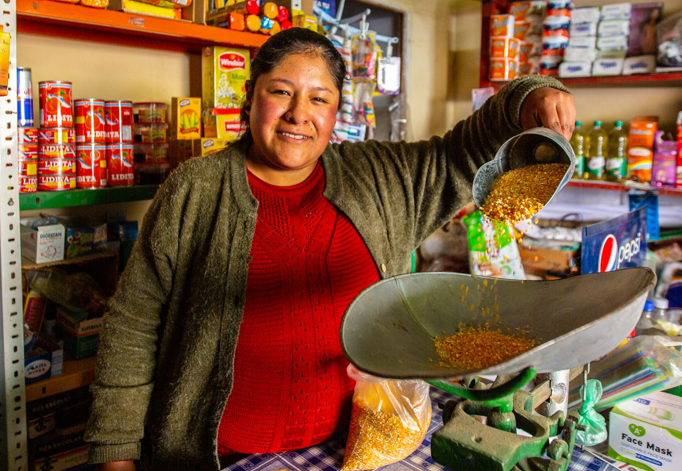
For women in the informal economy, entrepreneurship can be a catalyst for formal work and financial autonomy. But addressing issues of informal labor and improving socioeconomic mobility for women requires collaborative effort, said Carmen Correa, CEO of Pro Mujer, a nonprofit supporting women entrepreneurs in Latin America.
“Mainstreaming gender is essential as it allows us to look at our entire operation from the lens of inclusion, equity, and also diversity, promoting profound transformations in central issues such as the care economy and also equal pay,” Correa said. “We must all be participating.”
Redistributing household and care work, decreasing the digital gap, and improving women’s access to capital and upskilling should all be priorities, she added.
Havovi Wadia, Interim Managing Director Programs at the Freedom Fund, discussed the connection between informal work and exploitation. She stressed that many workers in the informal sector are more vulnerable to child labor, extreme forms of exploitation, and all forms of modern slavery.
Wadia referenced domestic work as an informal industry that attracts many children, who often lack formal protections like contracts. Similarly, people without citizenship documents may also be pushed into informal, exploitative work — something the Freedom Fund is actively working against.
“More explicit effort also has to be made to help undocumented people access citizenship documents and government services,” Wadia said.
The Freedom Fund is also currently working to improve working conditions both at the policy level but also through normative change and worker-led solutions that center workers’ experiences.
“They [workers] usually know the solution to those challenges as well. But the solution execution rests with those who have power, and that’s where international and national campaigns and pressure plays such a role in making those at the top of the supply chains accountable to supporting decent conditions of work,” Wadia said.
Lauren Whitehead, Lead for Social Protection and Gender at UNICEF, spoke about gender-based discrimination and inequities within the informal economy, noting that many women are prevented from working because they are burdened by unpaid care work.
Almost 12 times as many women than men say they cannot engage in formal work because of their unpaid caretaking responsibilities. And women between ages 24 and 34 are 25% more likely to be in poverty because of issues surrounding gender-based discrimination.
In response to these issues, UNICEF is focusing on family-based solutions including parental leave for both parents, opportunities for exclusive breastfeeding for at least six months, and affordable, quality childcare.
CGI looks forward to building on the momentum achieved during this event by accelerating and supporting partnerships globally that seek to improve conditions and enhance opportunities for informal economy workers.
Panelists in CGI’s “Bolstering Economic Security for Informal Economy Workers” included: Françoise Carré, Ph.D., Statistics Program Director, Women in Informal Employment Globalizing and Organizing; Carmen Correa, CEO, Pro Mujer; Herwig Immervoll, Head of Employment-Oriented Social Policies and Senior Economist, Organization for Economic Co-operation and Development; Yash Ranga, Impact Strategist, Director, Strategy and Innovation, PYXERA Global; Nishat Tabassum, Manager, Fund Excluded Workers Coalition; Havovi Wadia, Interim Managing Director of Programs, Freedom Fund; and Lauren Whitehead, Lead for Social Protection and Gender, UNICEF.