
 post | August 30, 2019
25 years ago, on August 31st 1994, a statement from the Irish Republican Army (IRA) announced a “complete cessation of military operations.” It said that “an opportunity to secure a just and lasting settlement has been created… A solution will only be found as a result of inclusive negotiations.”
It was as Nobel Laureate Seamus Heaney said at the time “a space in which hope can grow.” Many people, in Ireland, in Britain, in Irish America and elsewhere contributed to creating the opportunity for that initiative. The bi-partisan approach by Republican and Democratic representatives in the Congress played a central role.
Foremost among those who contributed to the efforts to achieve an agreement was President Bill Clinton who engaged in the search for peace even before he was elected President, and stayed with it throughout his Presidency and in the years since.
President Clinton’s positive approach to the creation of an Irish peace process was first evident in April 1992. That month a forum was held in Manhattan on Irish issues for the then democratic Presidential hopefuls, Jerry Brown and Bill Clinton. It was organised by Irish American John Dearie. Asked by one of the panellists if he would appoint a peace envoy for the north Clinton said he would. Asked if he would authorise a visa for me and other Sinn Féin representatives to visit the USA. Clinton said yes. As President he honoured these commitments.
In a letter published later that year Bill Clinton acknowledged that; “A permanent and peaceful solution to the crisis in Northern Ireland can only be achieved if the underlying cause of the strife and instability is dealt with vigorously, fairly and within a time frame that guarantees genuine, substantial and steady progress…”
At the end of January 1994, I applied for a visa to attend a conference organised by Bill Flynn’s National Committee on American Foreign Policy. There was huge resistance to this from the British government and also from senior people within President Clinton’s Cabinet. The British Embassy claimed that a visa for me would be a diplomatic catastrophe.
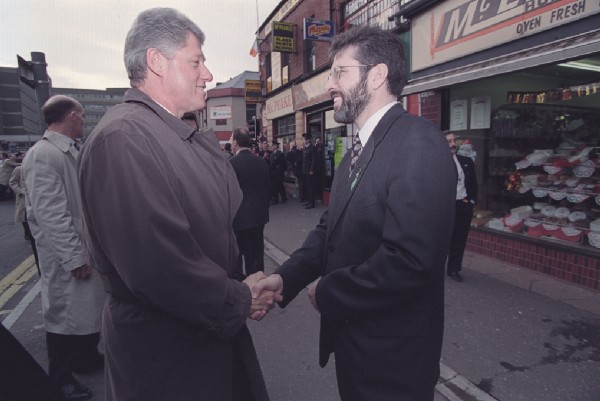
On the other side Ted Kennedy and three Democratic Senate colleagues, Chris Dodd, John Kerry and Daniel Moynihan wrote to President Clinton backing the visa. Others on Capitol Hill and in Irish America rallied to the issue.
On January 30th, 1994 President Clinton decided to give me a restricted visa for New York, for two days. It was a courageous decision. But it was not his last. The following year he agreed to allow US Citizens to raise funds for Sinn Féin and to invite me to the White House St. Patrick’s Day event. The British were furious. Consequently, for five days, the British Prime Minister refused to take a telephone call from the President of the United States.
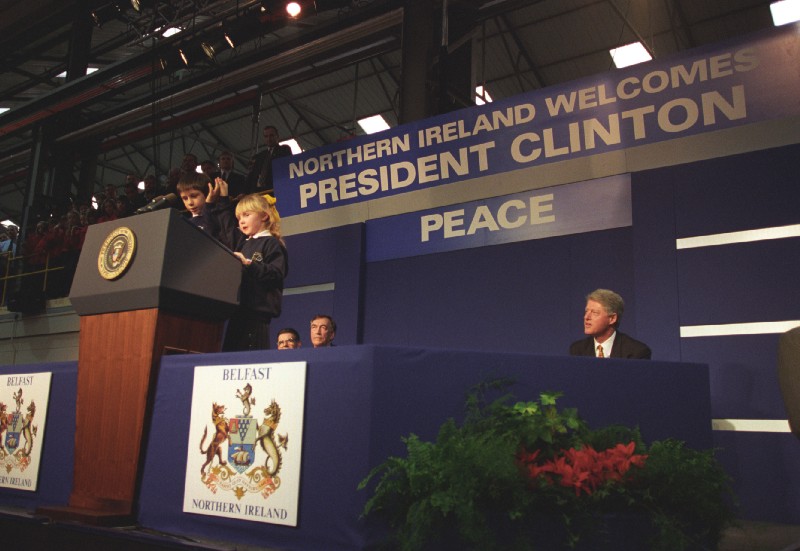
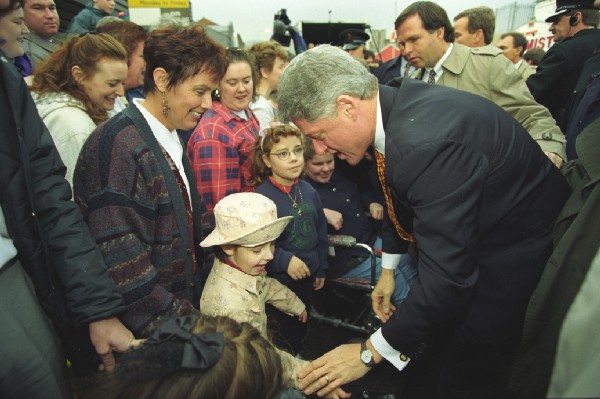
President Clinton’s visit to Ireland in November 1995 for a time unlocked the political stalemate that threatened the peace process. He was enthusiastically received everywhere and that visit is regarded by many as one of the highlights of that period of our history.
President Clinton’s decision to appoint George Mitchell as his special envoy to the North of Ireland and then later to the Chair of the peace negotiations, significantly contributed to their success and to the achievement of the Good Friday Agreement. Throughout that process President Clinton was at the end of the telephone, especially on the last night. I have no doubt that his engagement helped to get the Agreement over the line.
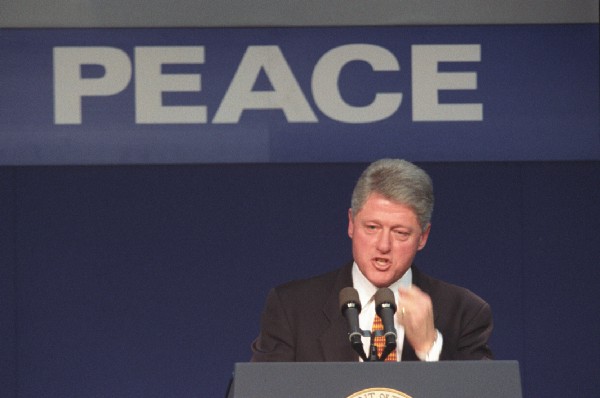
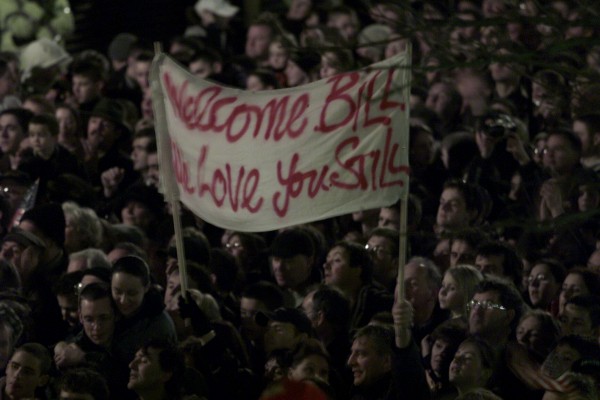
His contribution to navigating the peace process through the difficulties of ending conflict, reaching agreement and creating a new peaceful environment, was hugely important. His willingness to listen to the concerns and advice of Irish America leaders; the political initiatives he took, including the visa; his willingness to enter into dialogue while others were still refusing to talk; his subsequent visits to Ireland and encouragement of political agreement and progress; as well as investment by both the US government through the International Fund for Ireland, and business leaders, all contributed to the stability and success of the peace process.
Of course, that process still requires constant attention. A quarter of a century since the IRA’s courageous ‘complete cessation of military operations’, rights are still being denied to citizens, the power sharing government at Stormont has collapsed and Brexit threatens the Good Friday Agreement and it seems that a hard border will once again be established on our island.
So, we must remain perpetually vigilant and protective of all that has been hard won. Making peace is never a single action, although single actions can advance or set back progress. Making peace is a process.